
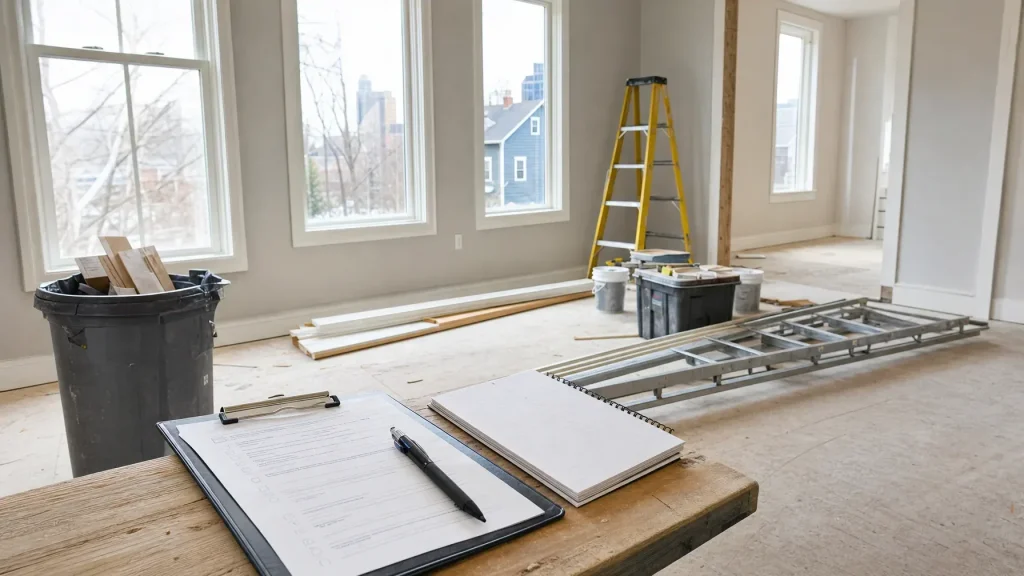
Good post-construction cleaning starts with a clear handoff from the contractor. Before agreeing on the cleaning date, confirm what work remains, what materials will stay on site, which areas need cleaning and who can resolve questions.
Ask the contractor to explain the project status and finish-care requirements. Give the cleaning provider that information so they can confirm the requested scope and whether the proposed visit fits the site's condition. On larger projects, Purge & Polish plans two passes: a rough clean after the messy trades finish, then a final detail before handover. Fine dust hides in vents, light fixtures and trim, so those get detailed on the final pass.
Confirm what is finished and what still needs work
Ask for a room-by-room update rather than relying on “the build is done.” Remaining sanding, cutting, drilling, painting or installation work may affect the cleaning plan. A return visit by a trade can also mean people and materials moving through areas you expected to be available.
- Ask which tasks remain, where they will happen and when the contractor expects them to finish.
- Identify work that could create more dust, residue or traffic through the proposed cleaning area.
- Ask whether trades need to return after cleaning and which rooms or routes they will use.
- Share the outstanding-work list with the cleaning provider before treating the date as settled.
Assign responsibility for tools, materials and debris
Construction leftovers are not all waste. Spare flooring, replacement tiles, unopened supplies and contractor equipment may need to stay. Ask the contractor to identify these items and confirm where they will be stored so they are not mistaken for material authorized for removal.
- Tools and equipment: Confirm who will collect them and whether they obstruct requested cleaning areas.
- Retained materials: Record what stays, who owns it and its intended storage location.
- Debris and packaging: Identify who is responsible for removal and confirm any requested hauling separately, such as construction debris removal.
- Protective coverings: Ask the contractor who should remove them and whether the underlying finish has restrictions.
Purge & Polish can haul leftover debris and packaging in the same visit as the clean, so mark which piles go and which stay. Describe what remains and ask the provider to confirm acceptance, responsibility and any effect on the cleaning scope. Leave contractor equipment and heavy materials for the responsible party rather than moving them to prepare the site.
Describe the requested cleaning by room and surface
Replace “clean everything” with a room-by-room request. Identify the renovated rooms, adjacent areas you want considered and spaces that are excluded. Within each area, name the surfaces or concerns you want the provider to assess, such as cabinet interiors, window tracks, trim or floors.
Distinguish loose dust from marks, attached residue, damaged finishes and unfinished installation. Ask the contractor about anything whose cause is uncertain. The cleaning provider should confirm what they can address, what needs further assessment and what remains outside the agreed work. Do not assume every mark or construction residue can be removed.
Pass along surface-care information
Request available manufacturer or installer instructions for new flooring, stone, cabinetry, glass, coatings and other finishes. Share the product identity and written care guidance with the cleaning provider, including any restrictions on moisture, products, abrasion or when cleaning may begin.
If the material or finish is unknown, flag it as unresolved instead of guessing. Ask the contractor, installer or manufacturer for clarification, then have the provider confirm whether the requested cleaning is appropriate. Keep known chips, scratches and other damage separate from the cleaning request.
Note Suspected asbestos, lead paint, unidentified dust or mold covering more than about 10 square feet is not an ordinary cleaning question. Do not disturb or test-clean the material; the EPA advises against dusting, sweeping or vacuuming debris that may contain asbestos. In Massachusetts, paid work that disturbs paint in homes built before 1978 generally must be done by a contractor licensed by the state Department of Labor Standards as a Lead-Safe Renovation Contractor; the state runs this program in place of the federal EPA rule. Refer unresolved concerns to qualified professionals before planning cleaning in the affected area.
Confirm access and site restrictions
Entry arrangements need to match the actual job site. Confirm who controls access, which routes are available and whom the cleaning team should contact if conditions differ from the description.
- Provide the address, unit or work-area details and the authorized arrival contact.
- Confirm entry and lockup arrangements, including any building-management requirements.
- Share parking, loading, elevator and permitted working-hour restrictions where applicable.
- Ask the provider what utilities and site conditions they need, and have the responsible party confirm availability.
- Identify restricted rooms, protected finishes and routes still needed by trades or occupants.
Keep a readiness list with an owner for each open item
- Project status: Has the contractor identified remaining work that could affect cleaning?
- Materials: Is responsibility clear for equipment, retained supplies, coverings and debris?
- Scope: Has the provider confirmed requested areas, tasks, exclusions and unresolved concerns?
- Surface information: Have care instructions and uncertain materials been addressed?
- Access: Are entry, restrictions and the authorized decision-maker confirmed?
Agree who will notify the provider if work runs late, more debris appears or access changes. Send updated room notes or photos when useful, and ask whether the change affects scope or scheduling. An unresolved item should lead to a decision, such as clarification, exclusion or rescheduling, rather than an assumption that the cleaning team will sort it out on arrival.
Discuss your project with Purge & Polish
Purge & Polish offers post-construction cleaning. Use the service page to learn more, then share your project status, remaining materials and requested work so the scope can be discussed for your site. You can request a quote when the handoff details are ready.
The service area extends from Worcester through MetroWest into Boston. Check the communities served when planning your renovation handoff.
Related service: Construction debris removal
Sources
- U.S. Environmental Protection Agency, Protect Your Family from Exposures to Asbestos (leave suspected asbestos alone; do not dust, sweep or vacuum debris that may contain asbestos; use trained, accredited asbestos professionals; checked November 11, 2026).
- U.S. Environmental Protection Agency, Lead Renovation, Repair and Painting Program (federal lead-safe renovation rule, background; checked November 11, 2026).
- Commonwealth of Massachusetts, Lead-safe renovation for contractors (Massachusetts licenses lead-safe renovation contractors through the Department of Labor Standards; checked November 11, 2026).
- U.S. Environmental Protection Agency, A Brief Guide to Mold, Moisture and Your Home (if you hire someone for mold cleanup, make sure they have mold cleanup experience; larger areas, about 10 square feet or more, call for EPA's professional cleanup guidance; checked November 11, 2026).